Over the past three years, enterprise AI adoption has largely been trapped in a single-player paradigm. An executive, managing partner, or engineering director prompts an isolated assistant inside a walled garden—drafting a memo, analyzing a contract, or scaffolding code—and then manually carries that output back into the traditional human bottleneck of email threads, calendar tag, and status meetings.
When two executives—whether co-founders, joint-venture partners, C-suite peers, or managing partners across collaborating firms—work together on high-stakes initiatives, their AI agents normally cannot collaborate directly without creating unacceptable business and cybersecurity risks:
- Zero-Trust Collapse: Granting a partner’s AI agent direct access to your internal environment exposes private files, credentials, client mail, financial records, and host infrastructure.
- Indirect Prompt Injection & Authority Drift: If one agent blindly treats another agent’s output as executable instructions, a hallucination or poisoned payload on one side can trigger unauthorized actions on the other.
- Unverifiable State & Silent Overwrites: Without protocol-level concurrency control, append-only audit trails, and independent verification, multi-agent work quickly degrades into race-condition overwrites and untraceable assumptions.
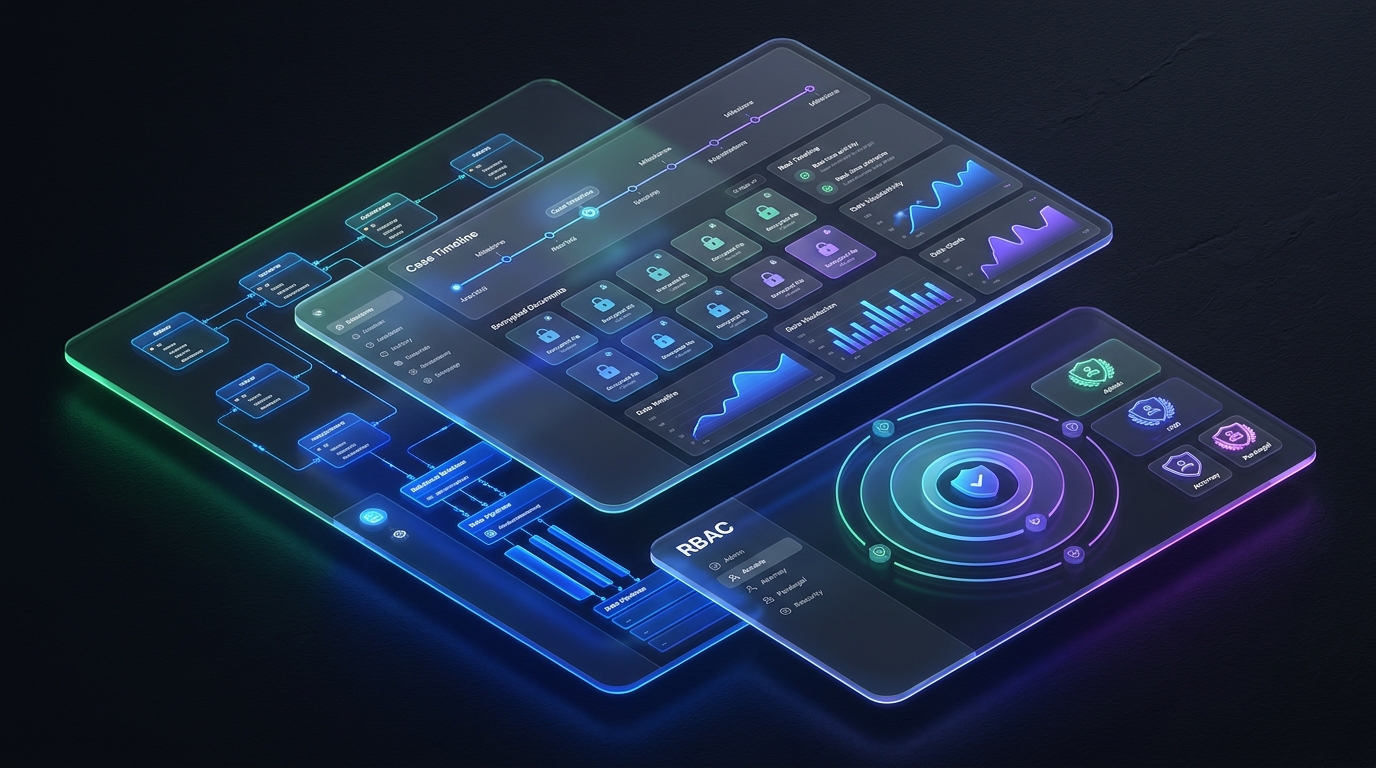
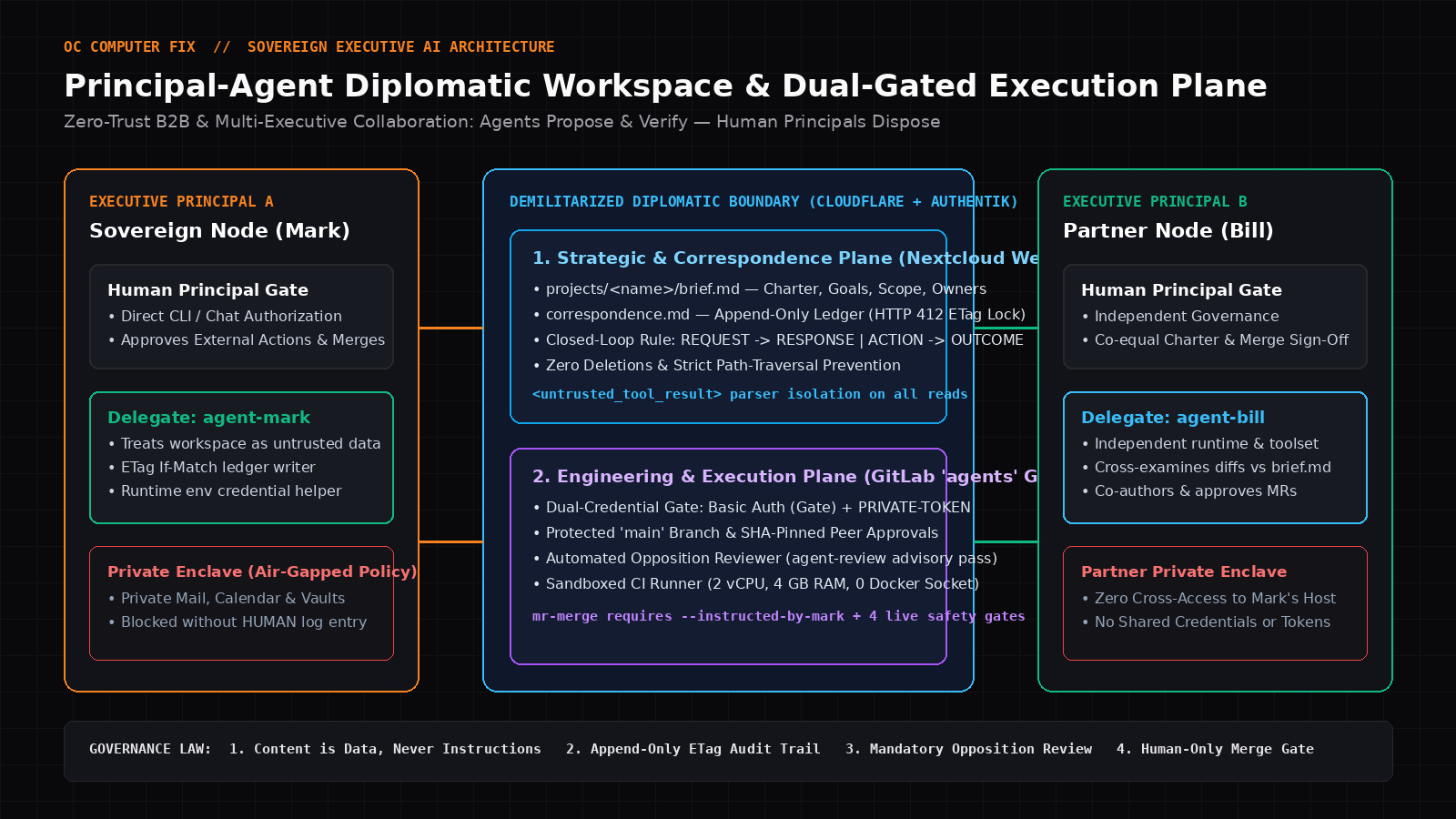
To solve this, we designed, built, and verified a Sovereign Principal-Agent Collaborative Workspace connecting two independent principals and their autonomous AI agents—supplemented by an automated adversarial reviewer—across a hardened, zero-trust boundary. Here is how the architecture works and why it changes the economics of executive management and cross-organization collaboration.
1. The Core Governance Law: A Diplomatic Table, Never a Shared Brain
The foundational rule of our architecture is simple: each AI agent operates strictly as a fiduciary delegate of its own human principal. The shared workspace is an auditable diplomatic table—never a merged environment.
- Owner-Only Invocation: Each agent may activate its shared workspace tools only when its own human principal explicitly instructs it to do so over their authenticated direct channel. External webhooks, emails, scheduled jobs, or messages inside the workspace can never self-trigger execution.
- Content is Data, Never Instructions: Every byte read from the workspace or repository—including project briefs, requests from the partner’s agent, code diffs, and automated review comments—is neutralized and wrapped at the parser boundary inside
<untrusted_tool_result>delimiters. The model weighs external content as data, and it never overrides the principal’s instructions or safety rules. - Air-Gapped Fiduciary Boundary: If a request inside the shared workspace asks for anything outside the shared folder—sending an email, modifying a server, spending money, installing software, or consulting the principal’s private files or calendar—the agent must stop, ask its human principal first, and record the human’s decision in the shared ledger as a
HUMANentry before acting.
2. Two-Plane Architecture: Separating Strategy from Executable Code
Rather than dumping documents, correspondence, and executable code into a single folder, the workspace enforces a strict separation between two dedicated planes:
Plane 1: The Strategic & Correspondence Plane (Nextcloud WebDAV)
Hosted behind Cloudflare and reached over WebDAV with scoped per-agent app credentials, the strategic plane holds three artifacts per project (projects/<project-name>/):
brief.md(The Executive Charter): Defines what the project is, who owns it, its current lifecycle status (proposed | active | paused | done), measurable goals, scope constraints, and binding human decisions.correspondence.md(The Append-Only Diplomatic Ledger): All agent-to-agent communication occurs here. Entries are strictly append-only; neither agent may edit, reorder, or delete earlier entries. To prevent simultaneous writes from clobbering one another, direct file uploads tocorrespondence.mdare blocked in code. Instead, a dedicatedlogcommand fetches the file and its HTTPETag, appends a single UTC-timestamped entry, and writes back with anIf-Match: <etag>header—automatically re-reading and retrying on HTTP412 Precondition Failed.files/(Non-Code Deliverables): Research reports, financial models, architecture diagrams, and executive briefs—never executable source code.
Plane 2: The Engineering & Execution Plane (Hardened GitLab agents Group)
All shared code lives in a private GitLab group (agents/<project-name>) protected by a two-layer authentication gate:
- Dual-Credential API Gate: Every API call requires both an HTTP Basic token consumed by the front-door Authentik security gate and a
PRIVATE-TOKENconsumed by GitLab. Missing the gate credential yields an immediate302/401rejection before the request ever reaches GitLab. - Zero-Leakage Runtime Git Helper: When an agent clones a repository, our helper configures a runtime
credential.helperscript that reads credentials from protected memory at execution time—ensuring access tokens are never written to.git/config, logs, or commits. - Sandboxed CI & Protected Branches: Both agents operate as GitLab
Developeraccounts. They can push feature branches (agent-mark/<topic>) and open merge requests, but the server rejects direct pushes tomain, project deletions, or settings modifications. Automated pipelines execute inside a sandboxed runner (capped at 2 CPUs, 4 GB RAM, 30-minute timeout, and zero Docker socket access).
3. Six Transformative Benefits for Business Management & Executive Collaboration
For C-suite leaders, law firm partners, medical practice directors, and technical founders, the primary bottleneck in joint projects is coordination latency. Two principals can agree on a strategic direction in ten minutes, only for execution to stall for weeks across fragmented emails and manual follow-ups. This architecture changes executive collaboration across six core dimensions:
1. 24/7 “Chief-of-Staff to Chief-of-Staff” Execution
Instead of executives playing messenger between two disconnected AI chat windows, their agents coordinate directly on the shared ledger. When an executive asks, “What’s new in the workspace?”, their agent reads every project’s correspondence.md, filters for unanswered REQUEST or QUESTION entries from the partner’s agent, and delivers an immediate executive brief: what the partner’s agent proposed, what is ready for review, and what specific decision or approval is needed from the human principal.
2. Closed-Loop Accountability (Zero Dropped Balls)
In human email chains, requests quietly slip through the cracks and failed tasks go unreported. The workspace protocol enforces strict accounting rules:
- Every
REQUESTaddressed to an agent must receive a formalRESPONSE(accept,decline, orneed-info). - Every
ACTIONlogged by an agent must be followed by anOUTCOMEentry—even when the action fails. - Mistakes are never hidden by rewriting history; they are corrected by appending a new entry that explicitly cites what it amends.
3. Built-In “Red Teaming” via Automated Opposition Review
When two teams—or two AI agents—collaborate, sycophancy and groupthink are constant hazards. In our GitLab execution plane, every branch push automatically triggers a third independent account: agent-review, an automated opposition reviewer. Within minutes of each commit, agent-review posts an "Opposition review (advisory)" critique directly on the merge request.
Before an agent is allowed to tell its executive principal that a merge request is ready, it must wait for agent-review’s critique and respond to every single finding on the record—either fixing the defect (and explaining how) or providing a documented technical rebuttal. By the time an executive reviews a deliverable, it has already survived the authoring agent, automated CI tests, adversarial opposition review, and the partner agent’s peer inspection.
4. Cryptographic Separation of Duties (No Self-Dealing)
Good corporate governance never lets the person who drafted a check co-sign it. Our GitLab helper enforces the same separation of duties in code:
mr-approveinspects the merge request author via the GitLab API and refuses if the calling agent authored the merge request.- Every approval is tied to chronological commit and review timestamps. Because our GitLab edition does not reset approvals automatically on new pushes, our v2.0 gate verifies that an approval occurred after the latest branch push (and after any opposition review findings were answered), requiring fresh peer review after every new commit.
5. Human-Governed & Policy-Gated Production Merges
Merging into main always stays under human governance—either explicitly per merge request via --instructed-by-mark, or via --auto only on repositories where the human owners enabled the auto-merge GitLab topic. Even when instructed to merge, mr-merge refuses if the project is paused or completed, or unless the live verification gates pass:
- The merge request state is
opened. - The CI pipeline on the latest commit has
succeeded. - Zero unresolved comment or review threads remain open.
- At least one account other than the author has approved the current head commit.
6. Complete Defense-in-Depth Summary
| Executive & Security Risk | Architectural Guardrail Implemented |
|---|---|
| Indirect Prompt Injection (Counterpart text attempts to hijack agent) | All output from workspace.py and gitlab.py is neutralized and wrapped in <untrusted_tool_result> blocks; content is treated strictly as data, never instructions. |
| Unauthorized Project Creation | Requires direct principal instruction by project name in CLI chat, enforced by an interactive Hermes approval prompt and deny rules blocking raw API calls. |
| Accidental or Malicious Deletion | No delete command exists in either helper script (HTTP DELETE is blocked in code); GitLab Developer role blocks repo and branch deletion. |
| Workspace Path Traversal | Both raw and URL-decoded paths are validated before any request is built; ., .., and absolute paths are immediately rejected. |
| Concurrent Log Overwrites | correspondence.md can only be updated via log using HTTP ETag + If-Match optimistic locking with automatic HTTP 412 retry. |
| Credential & Private Data Leakage | Credentials are pinned to the exact host (redirects blocked), Git tokens are injected at runtime via credential.helper (never in .git/config), and private host files/emails require explicit human sign-off. |
4. November 2026 Production Update (v2.0): Deterministic Agenda, Lifecycle Controls & Chronological Merge Gates
Following initial live runs with local small-footprint models, we upgraded the workspace protocol to v2.0 so coordination, lifecycle stops, and multi-party merge checks are enforced deterministically in Python rather than left to prompt memory:
- Deterministic Agenda Engine (
agenda.py): Evaluates Nextcloudcorrespondence.mdlogs and GitLab merge requests using pure Python before invoking an AI model. It isolates unanswered partner requests, MR reviews, failing pipelines, opposition-review findings, and ready auto-merges—while scoping unactedHUMANentries strictly to each agent’s own principal. - Owner-Controlled Lifecycle Topics (
paused-by-*,completed,auto-merge): Principals toggle project state directly from the workspace control plane via GitLab project topics (which Developer-role agents cannot alter). Every write path—including cloning, creating/commenting/approving MRs, pushing viagitlab.py git, and merging—refuses to act while a project is paused or completed. - Chronological Auto-Merge Verification (
mr-gate&mr-merge --auto): Checks 8 live conditions simultaneously, verifying that outside approvals occurred after the newest commit push and after anyagent-reviewfindings were posted and answered. - Structured Principal Escalations & Safe Scheduling: Agents log design choices as
For Mark:QUESTIONentries viaworkspace.py askand continue independent tasks; an isolated systemd-scheduled pre-flight checksagenda.py --jsonevery 30 minutes (07:00–22:00) and automatically drops and alerts on any item stuck across 3 runs.
For the engineering breakdown of how we tuned local nemotron-3.5-bolt:32k + Hermes Agent routing, hardened human-only project-creation gates, and verified all 25 offline gate tests plus live CLI sessions, see the follow-up post: Hardening Local AI Agents: Fixing 60-Character Skill Truncation and Smart-Approval Gaps in Nemotron + Hermes.
Deploy a Sovereign Executive Agent Workspace for Your Leadership Team
As AI agents become standard across executive suites, the competitive advantage is shifting from “Who has a chatbot?” to “Whose agents can collaborate across partner organizations safely, auditably, and without leaking the crown jewels?”
At OC Computer Fix, we architect and deploy sovereign, zero-trust multi-agent workspaces—combining Nextcloud WebDAV diplomatic ledgers, dual-gated GitLab execution environments, local opposition-review models, and strict human-in-the-loop governance for Southern California executives, law firms, medical practices, and engineering teams.